
How to Search the Custer County Court Docket
Start with Nebraska JUSTICE, the statewide trial-court case search. Custer County does not run its own separate portal. Pick Custer from the county list. Then choose County Court or District Court. Add a case type such as Criminal, Civil, Probate, Small Claims, or Traffic. A party name or a case number is the best first fact to enter. The court level matters. A felony can begin at the County Court preliminary stage, and it may later carry a District Court record under the same events.
Treat the results as an index. They are not a clerk-certified record. Before opening anything, read the caption, the case number, the court, and the date. Common names deserve extra caution here. A similar caption alone never proves you found the right person. If nothing turns up, try the other court level. Change the year too. Then consider whether the record is old, newly filed, sealed, or otherwise restricted.
- Open JUSTICE and choose Custer County with the appropriate court level and case type.
- Enter a party name or case number, adding a year, judge, or attorney only when known.
- Match the caption and court, then open the Case Summary and Register of Actions.
- Check the event sequence for filings, settings, orders, judgment, or disposition rather than relying on one line.
- Ask the correct clerk for a document, image, or certified copy when a screen result is not enough.
JUSTICE for Custer County Docket Searches
JUSTICE is the court's case system. The name stands for Judicial User System To Increase Court Effectiveness. Its public search form lets you look up cases by party name, Custer County, case year, court type, case type, subtype, judge, and attorney. The county code is 04. It shows up in the number patterns. A single search can return up to 30 cases. Record details stay viewable for three calendar days under the posted terms. There is a $17 charge for each search. That held true when the terms were checked on August 29, 2026. You pay even when a search comes back empty. Fees can shift, so confirm the amount before you pay it.
Nebraska Judicial Branch e-services gathers filing, calendar, payment, and access tools in one place. E-filing there is for authorized filings only. It is not a public docket reader. A filing made today may not appear in JUSTICE until the nightly update, roughly 24 hours later. Take an urgent question straight to the clerk or the filed notice.
| JUSTICE field | Custer use | Practical limit |
|---|---|---|
| Party Name | Start with last name, first name, middle initial, or suffix when known. | Similar names can produce more than one case. |
| Court Type | Choose County Court or District Court before reading results. | A felony history can cross both levels. |
| Case Type | Use Traffic, Criminal, Civil, Probate, Juvenile, or Small Claims as appropriate. | Some types carry separate access limits. |
| Year and sort | Use a year, judge, attorney, or sort order to narrow a broad Custer search. | The official demonstration is a field guide, not a promise of live options. |
The Nebraska Judicial Branch runs the public search from its official site. The system is statewide, so read any Custer result with the local court and the case type in mind. That context keeps a docket entry tied to the right courthouse.
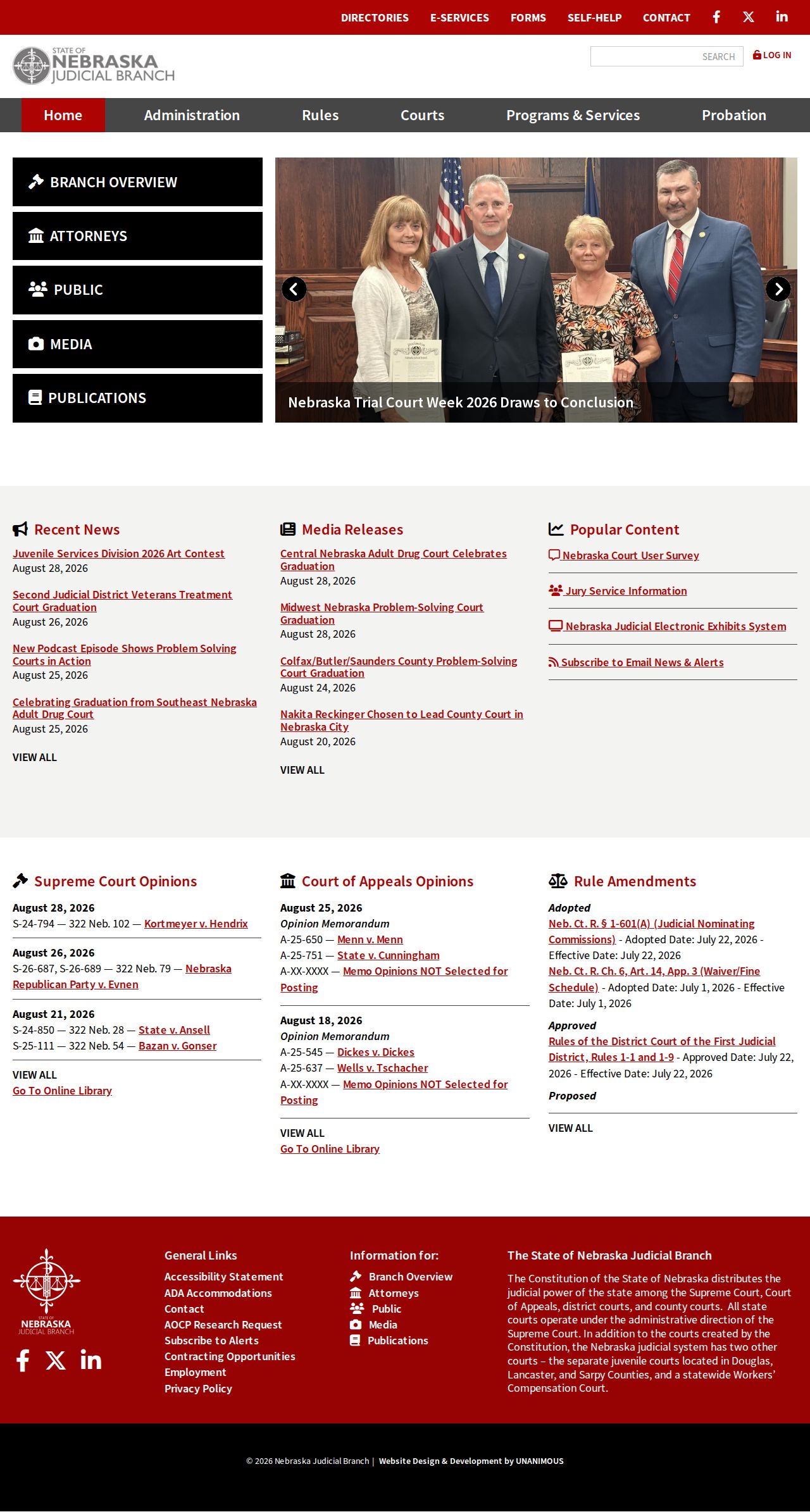
The state entry point separates a public case search from filing and administrative services.
What a Court Docket Shows
A Custer case file usually opens with two views: a Case Summary and a Register of Actions. The summary organizes the basics. It covers the court, county, case ID, caption, classification, dates, parties, disposition, and related details. The Register of Actions is the timeline. It lists each event, such as a complaint, motion, setting, order, judgment, payment entry, or satisfaction. The official District Court records-maintenance rule names five categories the clerk maintains. Those are the trial docket, general index, judgment index, financial record, and case file.
A single entry rarely tells the whole story. "Order" labels an event, not its contents. When precision matters, read a disposition alongside the underlying judgment or order. A missing image does not prove a document was never filed.
| Case number | An identifying format that may use C 04 CR YY ####### for County Court criminal or D 04 CI YY ####### for District Court civil patterns. |
|---|---|
| Caption and parties | The formal case title and roles, such as plaintiff, defendant, petitioner, or respondent. |
| Register of Actions | The dated sequence of filings, hearings, orders, and other case events. |
| Setting | A scheduled hearing, conference, or trial event. It is not necessarily the final result. |
| Financial or judgment entry | Record information that must be read separately from a current balance or a private agreement. |
| Disposition | The recorded resolution or status, subject to later orders, appeals, or corrections. |
Custer County Case Numbers and Record Terms
A Custer case number can reveal a lot. It shows the court, the county, the case type, the year, and the sequence. The official demonstration breaks numbers into those same components. There, 04 is the Custer County code. Think of the pattern as a reading aid. It never replaces the exact number printed on a summons, citation, notice, or clerk record.
- Register of Actions
- The official chronological summary of case events.
- Case Summary
- The structured overview of a case and its basic record fields.
- Setting
- A court event placed on a schedule, such as a hearing or trial.
- Bind-over
- The procedural move that can send a felony from County Court proceedings to District Court.
- Satisfaction
- An entry showing that a judgment or obligation was recorded as satisfied.
County Court and District Court sometimes use related terms differently. Give the clerk the court, the case number, the date, and whether certification is required, and the clerk can point to the right document name.
Which Courts Keep Dockets
Custer runs two primary trial-court levels. County Court is the usual starting place for many matters. That includes traffic, misdemeanors, municipal ordinance cases, small claims, probate, guardianship, adoption, juvenile matters, preliminary felony hearings, and civil cases within its jurisdiction. District Court handles felony trials after bind-over. It also takes larger civil matters, equity, domestic relations, and many appeals. Once a matter leaves District Court, the Nebraska Court of Appeals and the Nebraska Supreme Court keep their own separate trails.
Let the court named on the record guide the search, not the city on the citation. A city can hand you its ordinance text. Custer posts no separate municipal-court docket. Search County Court for a filed ordinance or traffic matter. Then move to District Court when the procedural history points there.
| Court | Docket covers | Where to search |
|---|---|---|
| Custer County Court | Traffic, misdemeanor, ordinance, small claims, probate, juvenile, preliminary felony, and county civil matters. | JUSTICE, calendar, courthouse terminal, or County Court clerk. |
| Custer District Court | Felony trial, larger civil, equity, domestic matters, judgments, and county appeals. | JUSTICE, calendar, courthouse terminal, or District Court clerk. |
| Nebraska appellate courts | Appeals from District Court and selected Supreme Court matters. | Use the appropriate appellate record, not the Custer trial-court search alone. |
Why Custer County Court Dockets Cross Courts
A felony often starts in Custer County Court with a preliminary hearing. It then continues in Custer District Court after bind-over. A County Court civil or small-claims appeal can also open a District Court path. That movement is why a name search at only one level can leave the procedural story half told. Begin with the court on your document. Then check the neighboring level whenever an entry signals a transfer, an appeal, or a later trial-stage case.
County Court jurisdiction makes the city route easy to misread. Traffic and municipal-ordinance matters from Broken Bow, Arnold, Callaway, Sargent, and Ansley belong to County Court once filed. The locality on a citation may explain the code context. It does not create a new city court record.
For a Custer felony or appeal, search records as a timeline across court levels. A matching name at one level is not enough to decide that the other level has no related event.
Finding Court Dates and Settings
Two searches can surface a Custer County setting. The Register of Actions may list one, and the statewide calendar offers a separate current and future search by date or last name. Choose County Court or District Court first, then Custer or District 8 as fits. A last-name search needs at least two characters. What appears can vary, but a calendar entry often includes the case number, caption, date, time, location, and a brief summary.
Keep the limits in mind. A calendar is a convenience. A summons, citation, notice, or signed order always controls. A reset, continuance, late update, sealed matter, or interface delay can explain a no-result response. For the full search path and help reading a setting, see the Custer County court calendar.
The Judicial Branch calendar landing page is the official entrance to the calendar service. It works well for a quick check. When an appearance is urgent, let the right clerk confirm it.
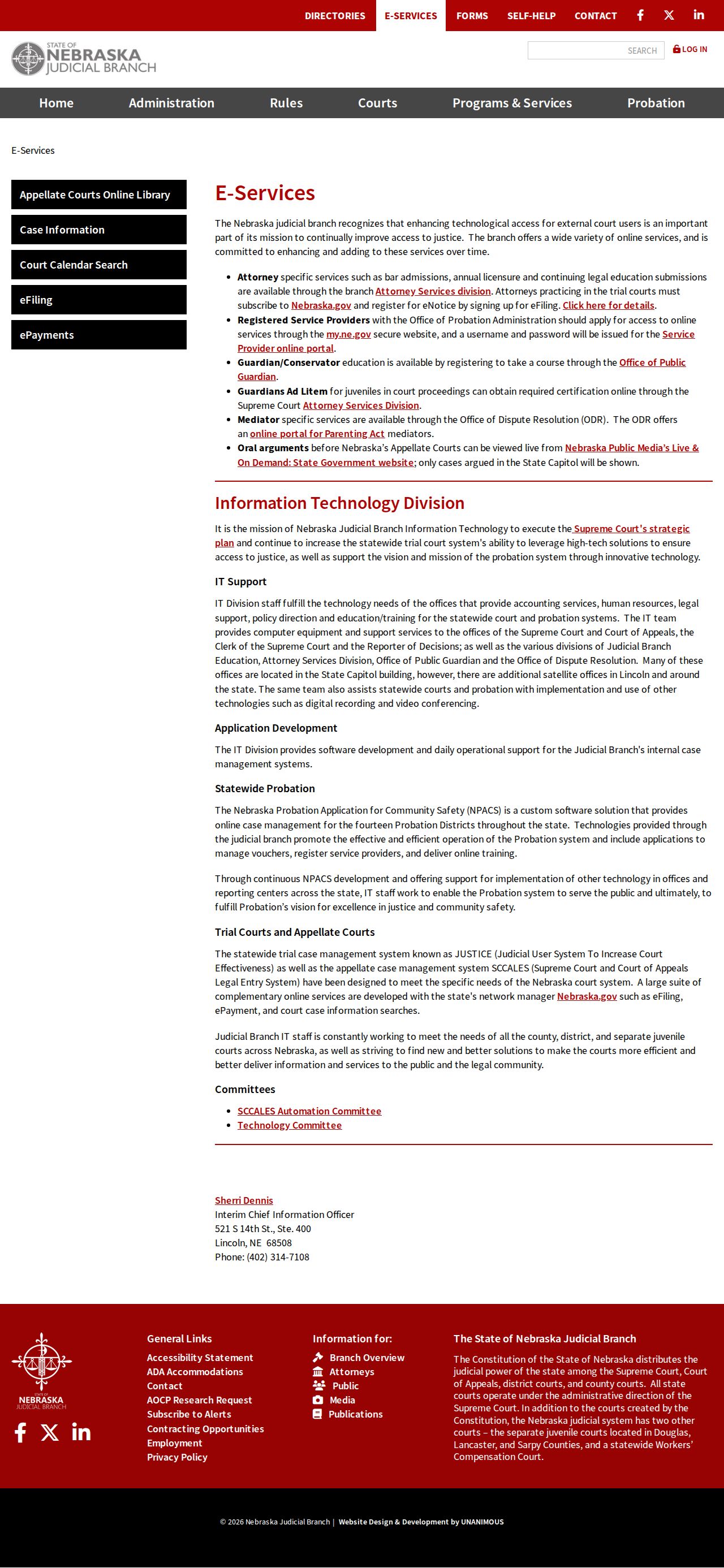
The statewide e-services view sits calendar access alongside other court tools. It keeps a setting search clearly separate from a case record, and that distinction matters when you track a hearing.
Custer County Court Calendar Results
A setting is a scheduled court event. It is not a promise it will occur at the listed moment. Calendars carry accuracy and timeliness limits. A missing entry does not prove there is no court date. Keep your citation, summons, or order. Match its case number and caption against the search result, and call the court that holds the matter when timing counts.
Most Custer traffic, ordinance, misdemeanor, small-claims, and probate settings run through the County Court calendar. District Court covers its own criminal, civil, domestic, and appeal settings. The county offers no separate coordinator line or guaranteed paper-posting schedule. A clerk's confirmation is far more reliable than a guess about a building posting.
Public Access to Dockets
Nebraska's Court Rules of Public Access to Records, Article 8, opens indexes, case summaries, Registers of Actions, calendars, judgments, orders, decrees, and available images through remote systems, courthouse terminals, and other authorized paths. The rule does not make every field or document public. Juvenile records, sealed matters, protected addresses, Social Security numbers, medical and financial information, victim and witness protections, and confidential filings can each limit a result.
So treat a redacted image or missing result with patience. It may reflect confidentiality, a scanning gap, a name variation, an update delay, or an older record. It is not proof a filing never existed. The clerk decides access to the official record.
Key Rules:
Nebraska Court Rules of Public Access to Records, Article 8 explains public court-record categories and the restrictions that still control access.
Nebraska Public Records Act §84-712 provides a route to inspect or copy public records, with allowed charges and response rules.
Nebraska Revised Statute §43-2,108 makes juvenile-court information confidential except as law permits.
Article 8 is the official rule itself. It explains why public search access runs in categories rather than one open file cabinet.
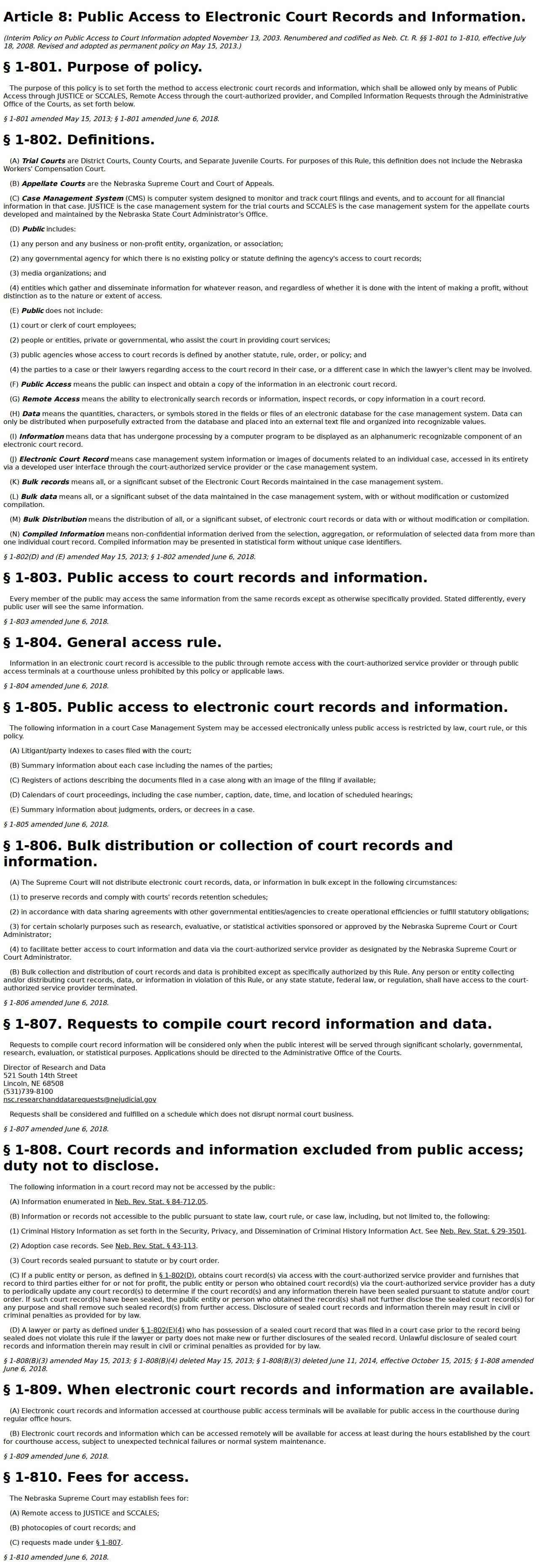
Access rules matter most when a docket result is sealed, limited, protected, or missing its image.
Custer County’s 1998 to 2001 Docket Boundary
Older Custer County docket research often needs a different plan. The JUSTICE FAQ dates the electronic record boundary. District Court went live in March 1998, County Court criminal and traffic in July 2000, and County Court probate, adoption, civil, small claims, and juvenile in January 2001. A matter filed before those dates may take a clerk request or archival research. Repeated online searches will not reach it.
Custer County's official history page supplies the county and place context behind this record history. Treat it as orientation. It is not a promise that every old file is online or stored at one address.
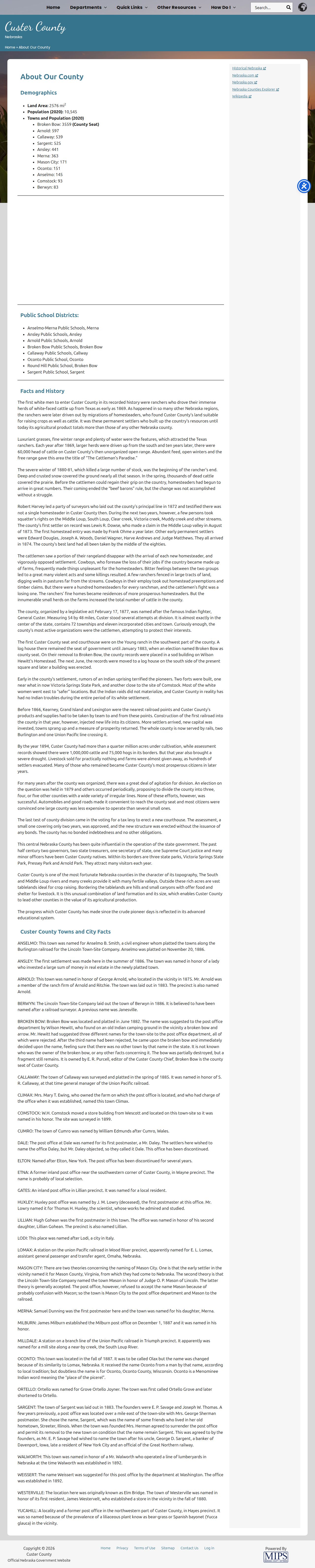
The county history helps with local orientation. For a particular older court record, the clerk and the archives remain the proper route. History Nebraska's Custer County guide lists 1885–1988 holdings in volumes, boxes, and microfilm. Before asking whether a record needs an archive route, give the clerk the court, case type, approximate year, and any case number.
The Clerk and Docket Records
Custer County splits its clerks by court. Debra Hansen, County Court Clerk/Clerk Magistrate, is the records starting point for traffic, misdemeanors, ordinance cases, small claims, probate, guardianship, adoption, juvenile matters, and County Court civil cases. Amy Oxford, Clerk of the District Court, is the starting point for District Court criminal, civil, mental-health, judgment, and docket records. Both offices sit at the state court's Judicial Center address, but they run different phone lines and hold different duties.
Make the request specific. Name the court, case number, document, date, format, and whether certification is needed. Terms like "Register of Actions," "Case Summary," "judgment," "order," "image," and "audio" work far better than a broad request for everything about a person. The Custer County court records page details copy and certification choices.
Custer County Court Clerk
Debra Hansen, Clerk Magistrate
604 Heritage Drive
Broken Bow, NE 68822
308-872-5761
Custer County Docket Clerks Use Different Offices
Watch the addresses on this one. The Judicial Branch lists the County Court and District Court offices at 604 Heritage Drive. A county-government event and contact page, though, gives 431 S 10th Avenue for the county courthouse. Those locations are not interchangeable. For a court record, start with the court office named on the case or call ahead before travel, especially for a sealed file, transcript, audio, or older record.
The county-government contact source uses that separate 431 S 10th Avenue address. It offers administrative-courthouse context, not a replacement for the court clerk's Judicial Center contact.
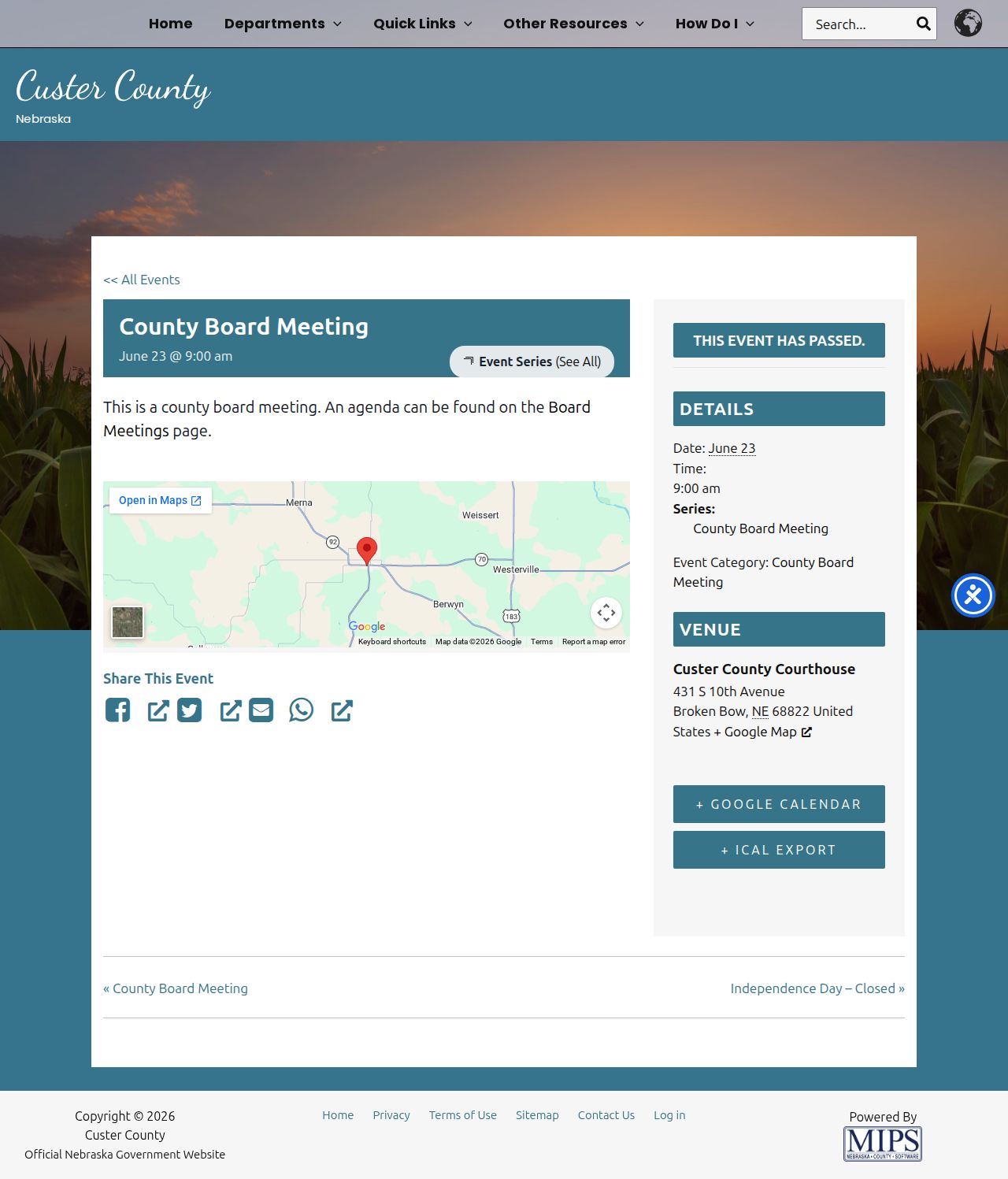
Custer County splits its docket work across two offices. Each address serves a different purpose. That distinction matters. Sending a records request to the wrong clerk can cost you days. For District Court records, call Amy Oxford at 308-872-2121.
The Judicial Branch posts County Court hours of 8:00 a.m. to noon and 1:00 p.m. to 5:00 p.m., Monday through Friday. Check for holiday closures before you drive over. Ask the clerk then about special procedures. Confirm whether any apply to the court records or hearing information you need.
Court Dockets by City in Custer County
The county's official 2020 table lists its five largest incorporated places. Those are Broken Bow, Arnold, Callaway, Sargent, and Ansley. Each one keeps city or village sources for government and local-code material. None of them offers its own municipal-court docket portal. A traffic ticket or ordinance matter filed in any of these towns still travels a single route. It goes through the Custer County Court via the JUSTICE system. The local government source, meanwhile, can help you pin down the ordinance behind the citation and its issuing context.
Broken Bow Court Docket
2020 population 3,559 · County Court and JUSTICE hold the court path.
Arnold Court Docket
2020 population 597 · Local code context rolls to the County Court record path.
Callaway Court Docket
2020 population 539 · Use County Court and JUSTICE for filed cases.
Sargent Court Docket
2020 population 525 · A city reference is not a separate court docket.
Ansley Court Docket
2020 population 441 · Court records remain on the county route.
Custer County Cities Have One Court Docket Route
City offices and court clerks in Custer County answer very different questions. A city ordinance page tells you what the local code says. A citation names an alleged violation. JUSTICE, by contrast, identifies the actual court case. The Register of Actions walks through the court events that follow. When you need a certified copy, only the clerk can issue it. That division of labor matters most in a rural county. There, a city hall, a county office, the Judicial Center, and a state portal can all surface in a single docket search.
A 2026 Judicial Branch notice highlighted activity at the Custer County Judicial Center. It also named both Custer clerks. That's a fresh local reminder that the court docket path sits apart from municipal administration.
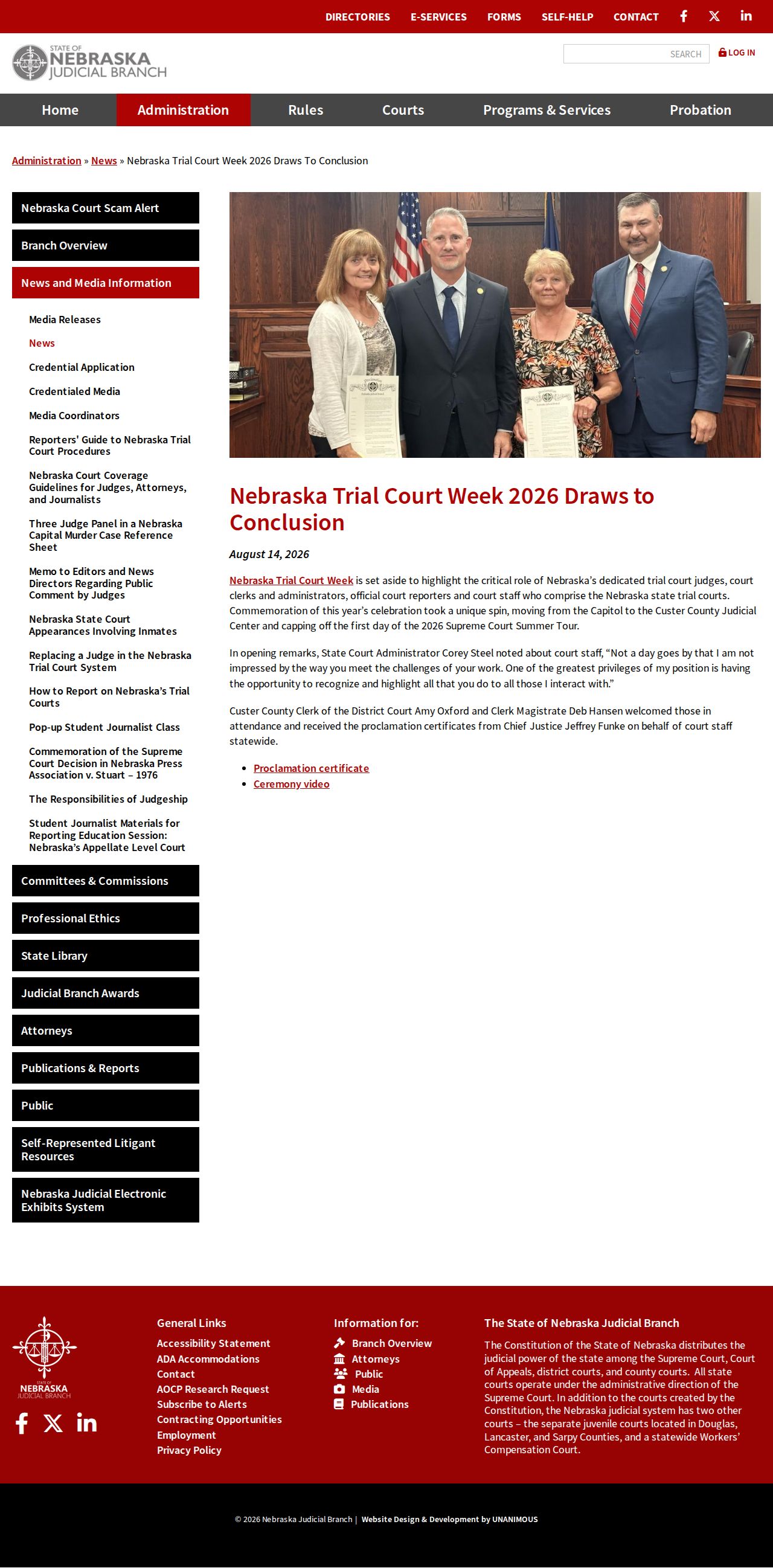
That notice is a current, official account of the Judicial Center's role in Custer County's state-court system.
Note: A city name in a citation, caption, or address never decides which court keeps the official court docket. Custer County does.
Map and Directions to the Custer Judicial Center
Custer District Court and Custer County Court both keep their records at the Custer Judicial Center, 604 Heritage Drive in Broken Bow. Clerk of the District Court Amy Oxford maintains District Court criminal, civil, mental-health, judgment, and docket records there, while County Court Clerk Magistrate Debra Hansen keeps traffic, misdemeanor, small-claims, probate, and juvenile records in the same building. Residents across the county's roughly 2,576 square miles route their court business to this single Broken Bow office.
Custer County Court Clerk
604 Heritage Drive
Broken Bow, NE 68822
308-872-5761
Monday through Friday, 8:00 a.m. to noon and 1:00 to 5:00 p.m.
Custer County's own government courthouse contact address, 431 South 10th Avenue, is a separate county-administration location and not the court clerks' office, so confirm the Heritage Drive address before a trip. Given the county's rural distances, calling the appropriate clerk ahead of a visit can confirm a record is ready and avoid a wasted drive.